
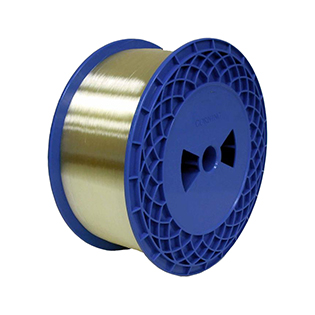
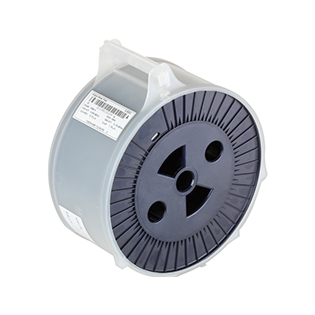
Description:
Bending Insensitive SM Fiber provides good resistance to macro-bending. It has low macro-bending sensitivity and low water-peak level. It is comprehensively optimized for use in O-E-S-C-L band (1260 – 1625nm).
It offers good resistance to additional losses due to low macro-bending in the 1625nm wavelength region. This not only supports L-band applications but also allows for easy installation without excessive care when storing the fibre, for example, in splicing cassettes. For cable use inside buildings, the fibre supports installation with small cable bending radius and compact organizers.
Bending Insensitive SM Fiber meets or exceeds the ITU-T Recommendation G.652.D/G.657.A including the IEC60703-2-50 type B1.3/B6.a1 Optical Fibre Specification.
Process:
This optical fibre is manufactured using the advanced Plasma Activated Chemical Vapor Deposition (PCVD) process. Because of the inherent advantages of the process, fibre show ultra accurate refractive index (RI) profile control, excellent geometrical performance, low attenuation and etc.
The optical fibre is coated with proprietary dual layer UV curable acrylate. This fibre coating system provides the fibre with superior environmental protection. Designed for more stringent tight-buffer cable application, the fibre also performs perfectly in loose buffer constructions and demonstrates a high resistance to micro-bending. Proprietary coating offers very stable coating strip force over a wide range of environmental conditions with no coating residue on the bare glass fibre. In fibre ribbon constructions, this coating system exhibits excellent performance in 60°C water-soak tests, exceeding 100 days. The coated optical fibre has high and stable values for the dynamic stress corrosion susceptibility parameter, which provides greatly improved fibre durability when used in harsh environments.
Application:
- Short pitch cables for special applications
- High performance optical network operating in O-E-S-C-L band
- High speed optical routes in buildings (FTTx)
- Cables with low bending requirements
Characteristics:
- Low attenuation satisfying the operation demand in O-E-S-C-L band
- Good bending loss resistance at short radius bends
- Low micro-bending loss for highly demanding cable designs including ribbons
- Low PMD satisfying high bit-rate and long distance transmission requirements
- Accurate geometrical parameters that insure low splicing loss and high splicing efficiency
Specification:
| Characteristics | Conditions | Specified Values | Units | ||
| Optical Characteristics: | |||||
| Attenuation | 1310nm | ≤0.35 | dB/km | ||
| 1383nm (after H2-aging) | ≤0.35 | dB/km | |||
| 1460nm | ≤0.25 | dB/km | |||
| 1550nm | ≤0.21 | dB/km | |||
| 1625nm | ≤0.23 | dB/km | |||
| Attenuation vs. Wavelength
Max. a Difference |
1285~1330nm,
in reference to 1310nm |
≤0.03 | dB/km | ||
| 1525~1575nm,
in reference to 1550nm |
≤0.02 | dB/km | |||
| Dispersion Coefficient | 1285~1340nm | -3.5 to 3.5 | ps/(nm·km) | ||
| 1550nm | ≤18 | ps/(nm·km) | |||
| 1625nm | ≤22 | ps/(nm·km) | |||
| Zero Dispersion Wavelength | — | 1300~1324 | nm | ||
| Zero Dispersion Slope | — | ≤0.092 | ps/(nm2·km) | ||
| Typical Value | — | 0.086 | ps/(nm2·km) | ||
| PMD | Maximum Individual Fibre | — | ≤0.1 | ps/ | |
| Link Design Value (M=20, Q=0.01%) | — | ≤0.06 | ps/ | ||
| Typical Value | — | 0.04 | ps/ | ||
| Cable Cutoff Wavelength | — | ≤1260 | nm | ||
| Mode Field Diameter (MFD) | 1310nm | 8.4~9.2 | um | ||
| 1550nm | 9.3~10.3 | um | |||
| Effective Group Index of Refraction | 1310nm | 1.466 | — | ||
| 1550nm | 1.467 | — | |||
| Point Discontinuities | 1310nm | ≤0.05 | dB | ||
| 1550nm | ≤0.05 | dB | |||
| Geometrical Characteristics: | |||||
| Cladding Diameter | — | 125.0±0.7 | um | ||
| Cladding Non-circularity | — | ≤0.7 | % | ||
| Coating Diameter | — | 235~245 | um | ||
| Coating-Cladding Concentricity Error | — | ≤12.0 | um | ||
| Coating Non-circularity | — | ≤6.0 | % | ||
| Core-cladding Concentricity Error | — | ≤0.5 | um | ||
| Curl (Radius) | — | ≥4 | m | ||
| Delivery Length | — | Up to 50.4 | Km/reel | ||
| Environmental Characteristics: (1310nm, 1550nm & 1625nm) | |||||
| Temperature Dependence Induced Attenuation | -60°C to +85°C | ≤0.05 | dB/km | ||
| Temperature-humidity Cycling Induced Attenuation | -10°C to +85°C, 98% RH | ≤0.05 | dB/km | ||
| Water-soak Dependence Induced Attenuation | 23°C, for 30 days | ≤0.05 | dB/km | ||
| Damp Heat Dependence Induced Attenuation | 85°C and 85% RH, for 30 days | ≤0.05 | dB/km | ||
| Dry Heat Aging | 85°C for 30 days | ≤0.05 | dB/km | ||
| Mechanical Specification: | |||||
| Proof Test | — | ≥9.0 | N | ||
| — | ≥1.0 | % | |||
| — | ≥100 | kpsi | |||
| Macro-bend Induced Loss | 10 turns around a mandrel of 15mm radius | 1550nm | ≤0.25 | dB | |
| 10 turns around a mandrel of 15mm radius | 1625nm | ≤1.0 | dB | ||
| 1 turn around a mandrel of 10mm radius | 1550nm | ≤0.75 | dB | ||
| 1 turn around a mandrel of 10mm radius | 1625nm | ≤1.5 | dB | ||
| Coating Strip Force | Typical Average Force | 1.5 | N | ||
| Peak Force | 1.3 – 8.9 | N | |||
| Dynamic Fatigue Parameter | — | ≥20 | — | ||
Reviews
There are no reviews yet.